
The Missing Discipline in Importing: Managing Your Capital Like You Manage Your Stock

Ryan Booysen
Foreign Exchange Specialist
20 July 2026
5 Min Read
Most South African importers fight for every cent on freight and squeeze suppliers over a 2% margin. Then the one cost in the whole transaction that nobody negotiates - turning rands into foreign currency - gets handed to whatever rate the bank quotes that morning. Here's what changes when you watch your money the way you watch your stock.
If you run an import business, you already run a tight ship. You track lead times. You chase suppliers. You watch stock levels so you never run out and never sit on dead stock.
But here's a question most importers never ask: who's watching the money itself?
For most business owners, the answer is nobody. The rands you send overseas every month just... go. Whatever rate the bank gives you that day is the rate you pay. No plan. No comparison. No second opinion.
And it's costing you money every single month, on every single payment - whether you notice it or not.
The question you're not asking
Running a supply chain means asking: how do I get the right stock, at the right time, at the right price?
But there's a second question underneath it: when I pay for that stock, am I getting a fair deal on the currency itself?
Most importers only ever ask the first one. You've negotiated hard with your suppliers. You've pushed back on freight costs more than once. But the actual conversion from rands to dollars - the thing sitting underneath every one of those payments - just happens.
Whatever the bank says, goes.
In 22 years of doing this, I've never met an importer who questions the exchange rate the way they question a supplier contract. They'll fight the contract line by line - and then take whatever rate the bank gives on the payment that settles it. It's happening every month, at businesses across South Africa, including some of the sharpest operators I know.
Where the money actually goes
The cost you can't see.
Your bank doesn't charge you an obvious fee on most international payments. Instead, it builds its cut into the exchange rate itself. There's a "real" rate - the one banks use when they trade with each other - and then there's the rate you're quoted. The gap between the two is what the bank keeps, and it's usually somewhere between 0.6% and 1%.
On a R500,000 payment, that's R3,000 to R5,000 gone before your supplier sees a cent. If you're sending R2 million a month, the same gap costs you R12,000 to R20,000 a month - R144,000 to R240,000 a year. Quietly. Automatically. And it never shows up as a cost on any statement, so nobody ever questions it.
The timing you leave to chance.
If you pay at whatever the rate happens to be on the day the invoice is due, you're not managing your currency cost. You're gambling on it. The rand can move a few percent between the day you order and the day you pay - and that move can wipe out the margin you fought so hard for on the stock itself. Most owners only see it after the shipment has landed and the damage is done.
The "relationship" that isn't one.
Phone your bank's forex desk and you'll get whoever picks up. Different person every time, no memory of your business, no idea what you paid last month. That's not someone looking after your money. That's a call centre with your name on a file.
What doing it properly looks like
You don't need to become a currency expert. You need three habits - the same habits you already apply to stock.
1. Know what you're actually paying.
Not the rate you're quoted - the real cost once the bank's cut is included, compared against what's genuinely available in the market. Most owners have never done this comparison. Not because it's hard. Because nobody ever told them it was worth doing.
2. Lock in your price when it matters.
You can book today's rate for a payment you'll only make next month. Whatever the rand does in between, your cost is fixed. That's not speculation - it's the same instinct you already use when you fix a freight contract or a fuel price. You're just applying it to your money instead of your stock.
3. Deal with one person who knows your business.
The value isn't only a better rate. It's someone who knows your payment cycle, phones you before a rand move costs you money, and picks up when there's a problem - instead of you hearing about it from a worried supplier.
“Every importer manages the supply chain.
The smartest importers manage the capital”
A real example
Last month we sat down with an importer who brings in stock from Southeast Asia every six weeks. Tight operation - freight negotiated hard, supplier terms known cold, not a shipment ever sitting idle. But they had never once checked their bank's exchange rate against what was actually available.
The gap wasn't small. Moving their payments to DG Capital gave them back margin they didn't know they were losing - on every single shipment - without touching a single supplier relationship or freight contract.
Nothing about their supply chain changed. Same suppliers, same freight, same stock cycle. The only thing that changed was who was watching the money underneath it.
The Takeaway
Every importer we've worked with runs the physical side of their business brilliantly. Stock, freight, suppliers - all tightly managed, all watched closely. The money side gets almost none of that attention. And it's the one cost nobody ever negotiates.
It's not carelessness. It's that nobody was ever given the job. Stock has an owner. Freight has an owner. The exchange rate on every payment usually doesn't - the person making the payment treats it like any other payment. They capture it, they release it, the supplier gets paid. Nobody questions the rate, because nobody knows there's a gap to question.
If you've never checked what your bank is really charging you on international payments, start there. That one number usually tells you exactly how much you've been giving away without knowing it.
One last thing. Closing blind spots like these is worth doing - but in our experience, the single biggest driver of stability isn't a better rate on any one payment. It's a consistent plan for when and how you lock your rates in. That's what keeps your landed costs steady when the rand doesn't cooperate. Fix the gap first. Then build the plan.
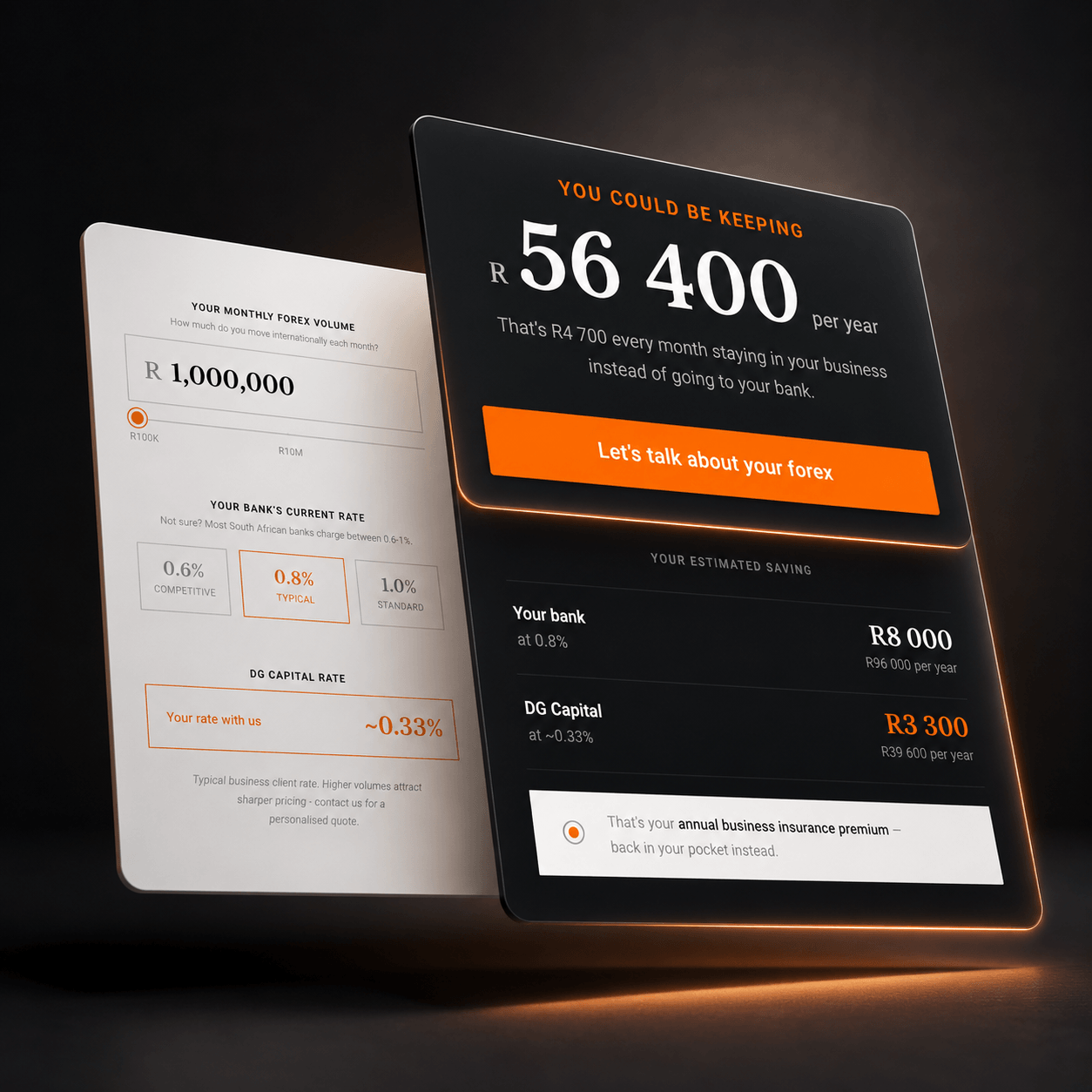
Want to see what your bank is actually charging you - and what you should be paying instead?
Try our Business Savings Calculator.
It takes less than 60 seconds, and the number usually speaks for itself.

20July 2026
5 Min Read
Ryan Booysen
Foreign Exchange
Specialist
Most South African importers fight for every cent on freight and squeeze suppliers over a 2% margin. Then the one cost in the whole transaction that nobody negotiates - turning rands into foreign currency - gets handed to whatever rate the bank quotes that morning. Here's what changes when you watch your money the way you watch your stock.
If you run an import business, you already run a tight ship. You track lead times. You chase suppliers. You watch stock levels so you never run out and never sit on dead stock.
But here's a question most importers never ask: who's watching the money itself?
For most business owners, the answer is nobody. The rands you send overseas every month just... go. Whatever rate the bank gives you that day is the rate you pay. No plan. No comparison. No second opinion.
And it's costing you money every single month, on every single payment - whether you notice it or not.
The question you're not asking
Running a supply chain means asking: how do I get the right stock, at the right time, at the right price?
But there's a second question underneath it: when I pay for that stock, am I getting a fair deal on the currency itself?
Most importers only ever ask the first one. You've negotiated hard with your suppliers. You've pushed back on freight costs more than once. But the actual conversion from rands to dollars - the thing sitting underneath every one of those payments - just happens.
Whatever the bank says, goes.
In 22 years of doing this, I've never met an importer who questions the exchange rate the way they question a supplier contract. They'll fight the contract line by line - and then take whatever rate the bank gives on the payment that settles it. It's happening every month, at businesses across South Africa, including some of the sharpest operators I know.
Where the money actually goes
The cost you can't see.
Your bank doesn't charge you an obvious fee on most international payments. Instead, it builds its cut into the exchange rate itself. There's a "real" rate - the one banks use when they trade with each other - and then there's the rate you're quoted. The gap between the two is what the bank keeps, and it's usually somewhere between 0.6% and 1%.
On a R500,000 payment, that's R3,000 to R5,000 gone before your supplier sees a cent. If you're sending R2 million a month, the same gap costs you R12,000 to R20,000 a month - R144,000 to R240,000 a year. Quietly. Automatically. And it never shows up as a cost on any statement, so nobody ever questions it.
The timing you leave to chance.
If you pay at whatever the rate happens to be on the day the invoice is due, you're not managing your currency cost. You're gambling on it. The rand can move a few percent between the day you order and the day you pay - and that move can wipe out the margin you fought so hard for on the stock itself. Most owners only see it after the shipment has landed and the damage is done.
The "relationship" that isn't one.
Phone your bank's forex desk and you'll get whoever picks up. Different person every time, no memory of your business, no idea what you paid last month. That's not someone looking after your money. That's a call centre with your name on a file.
What doing it properly looks like
You don't need to become a currency expert. You need three habits - the same habits you already apply to stock.
1. Know what you're actually paying.
Not the rate you're quoted - the real cost once the bank's cut is included, compared against what's genuinely available in the market. Most owners have never done this comparison. Not because it's hard. Because nobody ever told them it was worth doing.
2. Lock in your price when it matters.
You can book today's rate for a payment you'll only make next month. Whatever the rand does in between, your cost is fixed. That's not speculation - it's the same instinct you already use when you fix a freight contract or a fuel price. You're just applying it to your money instead of your stock.
3. Deal with one person who knows your business.
The value isn't only a better rate. It's someone who knows your payment cycle, phones you before a rand move costs you money, and picks up when there's a problem - instead of you hearing about it from a worried supplier.
“Every importer manages the supply chain.
The smartest importers manage the capital”
A real example
Last month we sat down with an importer who brings in stock from Southeast Asia every six weeks. Tight operation - freight negotiated hard, supplier terms known cold, not a shipment ever sitting idle. But they had never once checked their bank's exchange rate against what was actually available.
The gap wasn't small. Moving their payments to DG Capital gave them back margin they didn't know they were losing - on every single shipment - without touching a single supplier relationship or freight contract.
Nothing about their supply chain changed. Same suppliers, same freight, same stock cycle. The only thing that changed was who was watching the money underneath it.
The Takeaway
Every importer we've worked with runs the physical side of their business brilliantly. Stock, freight, suppliers - all tightly managed, all watched closely. The money side gets almost none of that attention. And it's the one cost nobody ever negotiates.
It's not carelessness. It's that nobody was ever given the job. Stock has an owner. Freight has an owner. The exchange rate on every payment usually doesn't - the person making the payment treats it like any other payment. They capture it, they release it, the supplier gets paid. Nobody questions the rate, because nobody knows there's a gap to question.
If you've never checked what your bank is really charging you on international payments, start there. That one number usually tells you exactly how much you've been giving away without knowing it.
One last thing. Closing blind spots like these is worth doing - but in our experience, the single biggest driver of stability isn't a better rate on any one payment. It's a consistent plan for when and how you lock your rates in. That's what keeps your landed costs steady when the rand doesn't cooperate. Fix the gap first. Then build the plan.
Want to see what your bank is actually charging you - and what you should be paying instead?
Try our Business Savings Calculator. It takes less than 60 seconds, and the number usually speaks for itself.
DG INSIDERS
Be the first to know what's happening with the markets,
what it means for you and what to do about it -
before it costs you money.
Delivered weekly, straight to your inbox.
DG INSIDERS
Be the first to know what's happening with the markets, what it means for you
and what to do about it -
before it costs you money.
Delivered weekly, straight to your inbox.

©2026 DG Forex Services.
All rights reserved.



©2026 DG Forex Services.
All rights reserved.