
The owner managed business: What It's Really Like Running an Import or Export Business Alone.

Ryan Booysen
Foreign Exchange Specialist
6 July 2026
5 Min Read
Running an import or export business alone means making important calls with no one to ask. You're the finance department, the compliance department, the risk manager all while chasing the supplier, calming the client, and checking the shipment - usually before lunch.
No induction. No handover. Just you, figuring it out as it comes.
If you import or export and you run the business yourself, you already know this. Every financial call that a company with a finance team hands to a specialist lands on your desk instead. You make it between a supplier call and a client meeting, usually without anyone to check it against, and usually without realising it was even a decision that needed making.
Here are five of them you're probably making right now, alone.
1. When to actually convert your currency
A finance team watches the rand daily and picks a moment to convert. You don't have that luxury. Most owner-run businesses convert whenever the payment is due, not when the rate is good - because nobody's job is to watch it, so nobody does.
That's not carelessness. It's just what happens when the job doesn't have anyone attached to it. Over a year of monthly supplier payments, the gap between converting on a good day and converting on a bad one can run into tens of thousands of rand - money that never shows up as a loss on any invoice, because it was never a cost anyone tracked.
2. Whether you should be using forward cover
Forward cover means locking in today's rate for a payment you'll make later. If the rand moves against you before that payment date, your cost stays the same. Most business owners have never had this explained to them properly, so they default to not using it - which means every future payment is a bet on where the rand will be, whether they meant to place that bet or not.
You don't need forward cover for every payment. But it's a decision, not a default, and right now it's being made for you by inertia rather than by choice.
3. Whether your bank's rate is actually any good
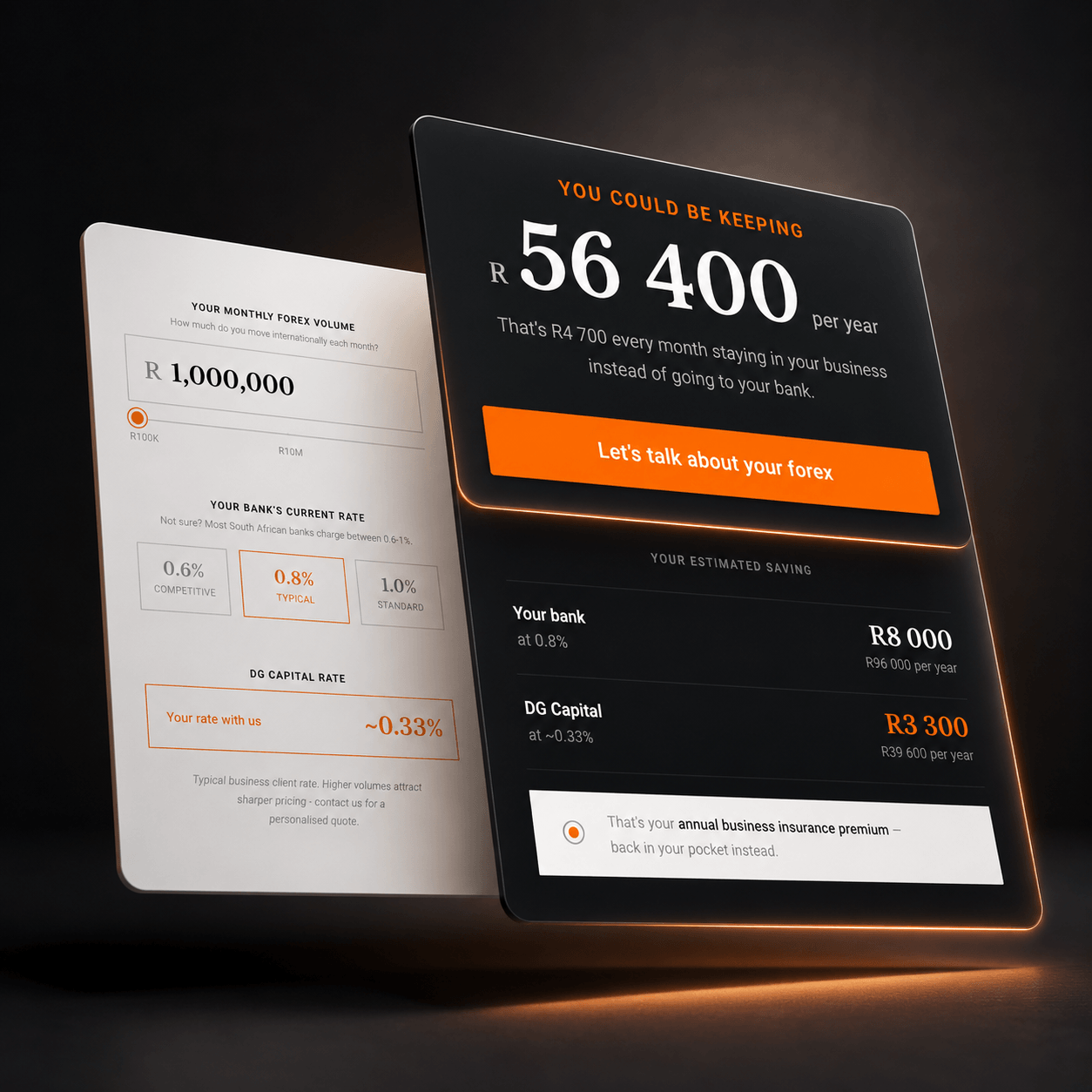
Nobody at your bank is going to tell you they're charging you more than the market rate. Banks typically sit around 0.6% to 1% above the interbank rate on business forex. A dedicated FX dealer can usually get you closer to 0.33%. On a business moving a meaningful volume of stock internationally each month, that gap adds up to a real number - one most owners have never actually calculated, because nobody handed them the job of checking.
4. How to structure a payment so it doesn't get stuck
Every payment to a supplier has to be classified with a BoP code - short for Balance of Payments code - which tells the Reserve Bank why the money is leaving the country. Advance payment, payment on delivery, and payment against a shipped invoice all use different codes and different supporting documents.
Get the code right and the documents don't quite match - a commercial invoice value that's slightly off from the payment reference, a missing proof of shipment - and the payment doesn't fail outright. It stalls. Silently. No error message. Just a payment sitting in a queue until someone catches it.
In 20 years of doing this, I've seen the same mismatch cause the same panic more times than I can count. It's almost never fraud, and it's almost never the business owner's fault. It's a one-line administrative gap that nobody flagged before the money left the account - and if there's no one at your business whose job it is to catch it, you find out when your supplier calls asking where their money is.
The frustrating part is that this happens even when you did everything right. Sometimes the code is correct, the documents are all in, and the payment still doesn't move - because nobody at the bank owns your transaction from start to finish. It sits in a queue, processed by whoever's turn it is. Call today and you speak to someone new, who opens your file and starts from zero.
5. What to do when something goes wrong and there's no one to ask
This is the one underneath all the others. A business with a finance team has someone who catches a wrong code before it becomes a crisis, someone who knows whether today's a good day to convert, someone who already asked whether forward cover makes sense this quarter. Run the business yourself, and that person is you - on top of sales, on top of ops, on top of the supplier call you now also have to make.
There's no one down the hall to check with. You work it out alone, usually after hours, usually under pressure, and usually for the first time - because these decisions don't come up often enough to get good at them on your own.
What this actually costs
None of these five decisions is difficult on its own. Together, made without anyone to check them against, they compound. A currency converted on the wrong day. A forward cover opportunity never considered. A rate nobody questioned. A payment held up for three days over a document mismatch nobody caught in advance. None of it shows up as a single, obvious loss - it just quietly erodes margin, month after month, on a business that's already working hard enough to survive without it.
Most business owners never planned to become their own CFO and their own compliance officer at the same time. It just happened, one decision at a time, because nothing was built to make it easier.
What actually changes this
The fix isn't a checklist. It's having one person who already knows your business well enough to make these calls with you instead of you making them alone - someone who watches the rate, flags forward cover when it's worth it, checks the documentation before the payment ever leaves, and picks up the phone when your supplier is asking questions you can't yet answer.
It's that you stop making every one of them by yourself.
That's exactly what DG Capital does.
One dealer - not a call centre, not a queue - who already knows your business well enough to watch the rate on your behalf, flag forward cover when it actually makes sense, and check the documentation before a payment ever gets the chance to stall. Because you finally have one person in your corner who treats your business like it's the only one on their desk that day.
Want to see what your business is actually paying on international payments right now, compared to what it could be?
Try the Business Savings Calculator and see the number for yourself.

6 July 2026
5 Min Read
Ryan Booysen
Foreign Exchange
Specialist
Running an import or export business alone means making important calls with no one to ask. You're the finance department, the compliance department, the risk manager all while chasing the supplier, calming the client, and checking the shipment - usually before lunch.
No induction. No handover. Just you, figuring it out as it comes.
If you import or export and you run the business yourself, you already know this. Every financial call that a company with a finance team hands to a specialist lands on your desk instead. You make it between a supplier call and a client meeting, usually without anyone to check it against, and usually without realising it was even a decision that needed making.
Here are five of them you're probably making right now, alone.
1. When to actually convert your currency
A finance team watches the rand daily and picks a moment to convert. You don't have that luxury. Most owner-run businesses convert whenever the payment is due, not when the rate is good - because nobody's job is to watch it, so nobody does.
That's not carelessness. It's just what happens when the job doesn't have anyone attached to it. Over a year of monthly supplier payments, the gap between converting on a good day and converting on a bad one can run into tens of thousands of rand - money that never shows up as a loss on any invoice, because it was never a cost anyone tracked.
2. Whether you should be using forward cover
Forward cover means locking in today's rate for a payment you'll make later. If the rand moves against you before that payment date, your cost stays the same. Most business owners have never had this explained to them properly, so they default to not using it - which means every future payment is a bet on where the rand will be, whether they meant to place that bet or not.
You don't need forward cover for every payment. But it's a decision, not a default, and right now it's being made for you by inertia rather than by choice.
3. Whether your bank's rate is actually any good
Nobody at your bank is going to tell you they're charging you more than the market rate. Banks typically sit around 0.6% to 1% above the interbank rate on business forex. A dedicated FX dealer can usually get you closer to 0.33%. On a business moving a meaningful volume of stock internationally each month, that gap adds up to a real number - one most owners have never actually calculated, because nobody handed them the job of checking.
4. How to structure a payment so it doesn't get stuck
Every payment to a supplier has to be classified with a BoP code - short for Balance of Payments code - which tells the Reserve Bank why the money is leaving the country. Advance payment, payment on delivery, and payment against a shipped invoice all use different codes and different supporting documents.
Get the code right and the documents don't quite match - a commercial invoice value that's slightly off from the payment reference, a missing proof of shipment - and the payment doesn't fail outright. It stalls. Silently. No error message. Just a payment sitting in a queue until someone catches it.
In 20 years of doing this, I've seen the same mismatch cause the same panic more times than I can count. It's almost never fraud, and it's almost never the business owner's fault. It's a one-line administrative gap that nobody flagged before the money left the account - and if there's no one at your business whose job it is to catch it, you find out when your supplier calls asking where their money is.
The frustrating part is that this happens even when you did everything right. Sometimes the code is correct, the documents are all in, and the payment still doesn't move - because nobody at the bank owns your transaction from start to finish. It sits in a queue, processed by whoever's turn it is. Call today and you speak to someone new, who opens your file and starts from zero.
5. What to do when something goes wrong and there's no one to ask
This is the one underneath all the others. A business with a finance team has someone who catches a wrong code before it becomes a crisis, someone who knows whether today's a good day to convert, someone who already asked whether forward cover makes sense this quarter. Run the business yourself, and that person is you - on top of sales, on top of ops, on top of the supplier call you now also have to make.
There's no one down the hall to check with. You work it out alone, usually after hours, usually under pressure, and usually for the first time - because these decisions don't come up often enough to get good at them on your own.
What this actually costs
None of these five decisions is difficult on its own. Together, made without anyone to check them against, they compound. A currency converted on the wrong day. A forward cover opportunity never considered. A rate nobody questioned. A payment held up for three days over a document mismatch nobody caught in advance. None of it shows up as a single, obvious loss - it just quietly erodes margin, month after month, on a business that's already working hard enough to survive without it.
Most business owners never planned to become their own CFO and their own compliance officer at the same time. It just happened, one decision at a time, because nothing was built to make it easier.
What actually changes this
The fix isn't a checklist. It's having one person who already knows your business well enough to make these calls with you instead of you making them alone - someone who watches the rate, flags forward cover when it's worth it, checks the documentation before the payment ever leaves, and picks up the phone when your supplier is asking questions you can't yet answer.
It's that you stop making every one of them by yourself.
That's exactly what DG Capital does.
One dealer - not a call centre, not a queue - who already knows your business well enough to watch the rate on your behalf, flag forward cover when it actually makes sense, and check the documentation before a payment ever gets the chance to stall. Because you finally have one person in your corner who treats your business like it's the only one on their desk that day.
Want to see what your business is actually paying on international payments right now, compared to what it could be?
Try the Business Savings Calculator and see the number for yourself.
DG INSIDERS
Be the first to know what's happening with the markets,
what it means for you and what to do about it -
before it costs you money.
Delivered weekly, straight to your inbox.
DG INSIDERS
Be the first to know what's happening with the markets, what it means for you
and what to do about it -
before it costs you money.
Delivered weekly, straight to your inbox.

©2026 DG Forex Services.
All rights reserved.



©2026 DG Forex Services.
All rights reserved.